Photographic work with a field-research bent. Species are named where they can be named and left open where a single photograph does not allow certainty — the same honesty that guides the research. A growing collection.
Fotografische Arbeit mit Feldforschungs-Bezug. Arten werden benannt, wo sie benennbar sind, und offengelassen, wo ein einzelnes Foto keine Sicherheit erlaubt — dieselbe Ehrlichkeit, die die Forschung leitet. Eine wachsende Sammlung.
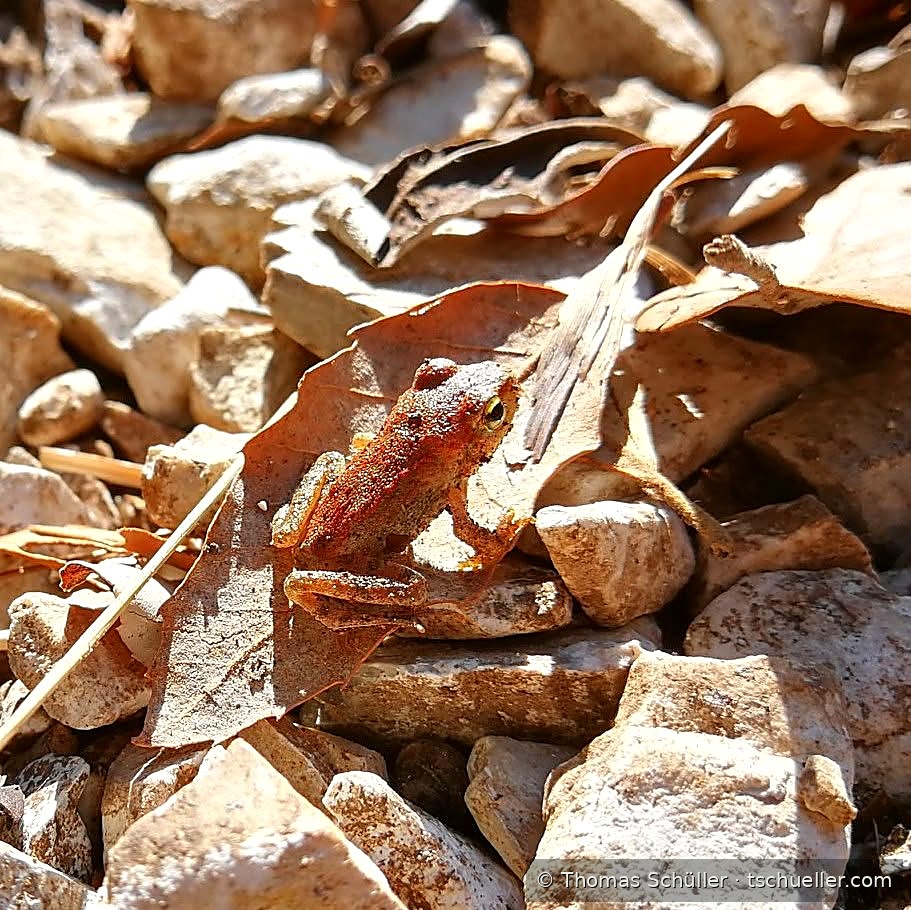
Rana cf. graeca · Olymp, Pieria · 2018
A recently metamorphosed brown frog on leaf litter among limestone scree — Mount Olympus, in the Pieria region of Greece (somewhere in the Litochoro / Katerini area; the exact spot in the massif is not documented). The mountain rises to 2,917 m at Mytikas and forms the border between the regional units of Pieria and Larissa, some 80 km southwest of Thessaloniki. It has been Greece's first national park since 1938 and a UNESCO Biosphere Reserve, with Natura 2000 habitats supporting over 1,700 plant species alongside amphibians, reptiles, and invertebrates. The species remains open — likely the endemic Greek stream frog (Rana graeca), but a juvenile cannot be reliably identified from a single photograph.
Ein frisch metamorphosierter Braunfrosch auf Falllaub zwischen Kalkschotter — Olymp, Region Pieria, Griechenland (irgendwo in der Gegend um Litochoro / Katerini; der genaue Ort im Massiv ist nicht dokumentiert). Der Berg erreicht am Mytikas 2.917 m und bildet die Grenze zwischen den Regionaleinheiten Pieria und Larissa, rund 80 km südwestlich von Thessaloniki. Seit 1938 ist er Griechenlands erster Nationalpark und UNESCO-Biosphärenreservat, mit Natura-2000-Lebensräumen für über 1.700 Pflanzenarten sowie Amphibien, Reptilien und Wirbellose. Die Artansprache bleibt offen — vermutlich der endemische Griechische Frosch (Rana graeca), doch bei einem Jungtier lässt sich das aus einem einzelnen Foto nicht sicher bestimmen.
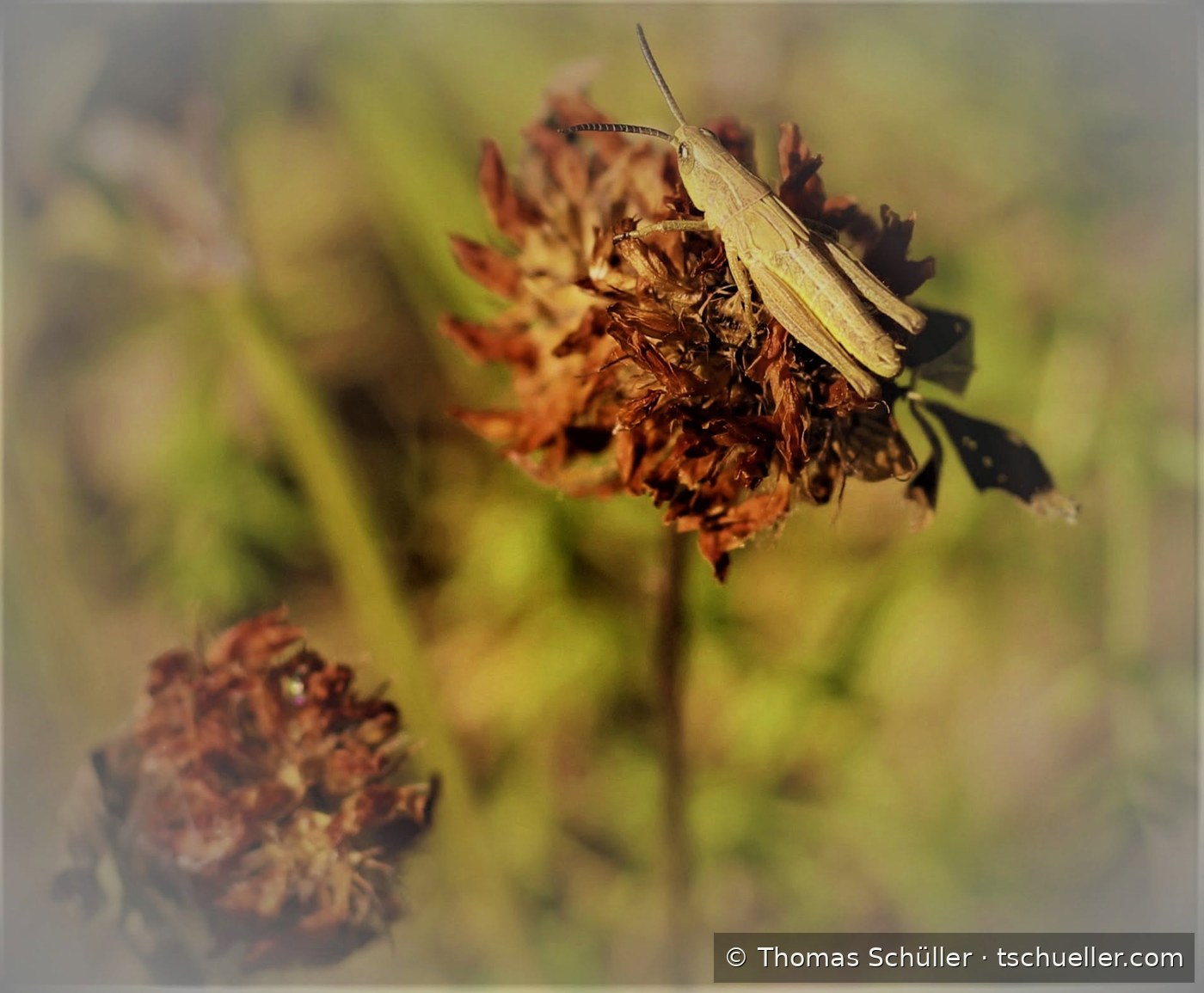
Chorthippus sp. auf Trifolium cf. pratense · Österreich · 2010–2018
A field grasshopper — probably a meadow grasshopper (Chorthippus sp.) — on the faded heads of red clover (Trifolium cf. pratense), Austria. Neither species nor exact place and date are documented: field grasshoppers can usually only be placed to genus from a photograph, since the decisive features lie in the shape of the pronotal keels and in the song.
Eine Feldheuschrecke — vermutlich ein Grashüpfer (Chorthippus sp.) — auf den verblühten Köpfen von Rotklee (Trifolium cf. pratense), Österreich. Weder Art noch genauer Ort und Zeitpunkt sind dokumentiert: Feldheuschrecken lassen sich aus einem Foto meist nur bis zur Gattung ansprechen, da die entscheidenden Merkmale in der Form der Halsschild-Kiele und im Gesang liegen.
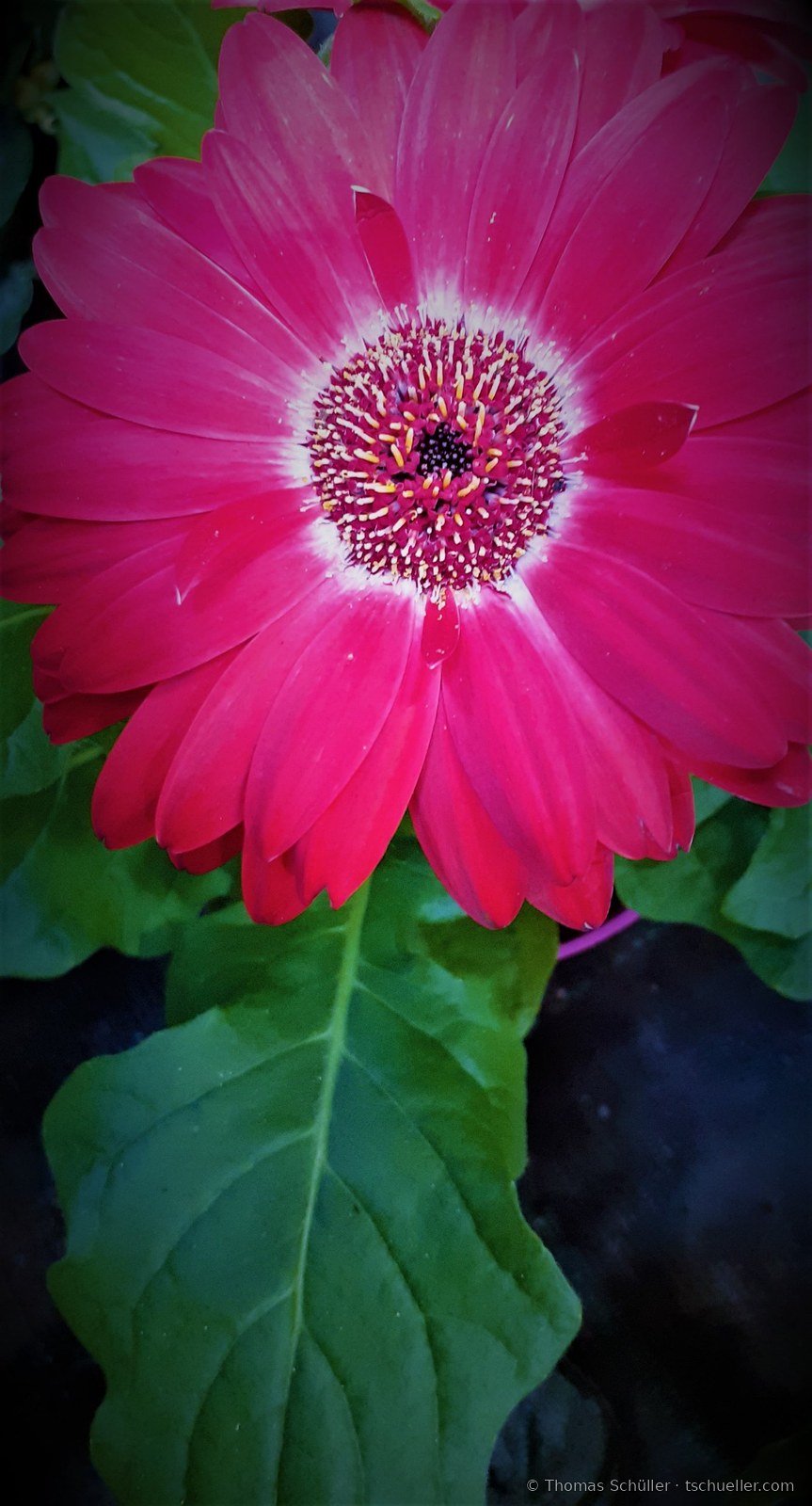
Gerbera belongs to the daisy family: what looks like one flower is a head of hundreds. Ray florets outside, disc florets inside, which open from the rim towards the centre — the yellow anthers show which ring is open. Location not documented.
Die Gerbera ist ein Korbblütler: was wie eine Blüte aussieht, ist ein Körbchen aus Hunderten. Außen die Zungenblüten, innen die Röhrenblüten, die vom Rand zur Mitte aufblühen — die gelben Staubbeutel zeigen, welcher Ring gerade offen ist. Ort nicht dokumentiert.
Between ray and disc florets lies an extra ring of short ray florets — a cultivated form. In the centre the still-closed disc florets, further out the open ones with yellow pollen. Location not documented.
Zwischen Zungen- und Röhrenblüten liegt hier ein zusätzlicher Kranz kurzer Zungenblüten — eine Zuchtform. In der Mitte die noch geschlossenen Röhrenblüten, weiter außen die geöffneten mit gelbem Pollen. Ort nicht dokumentiert.
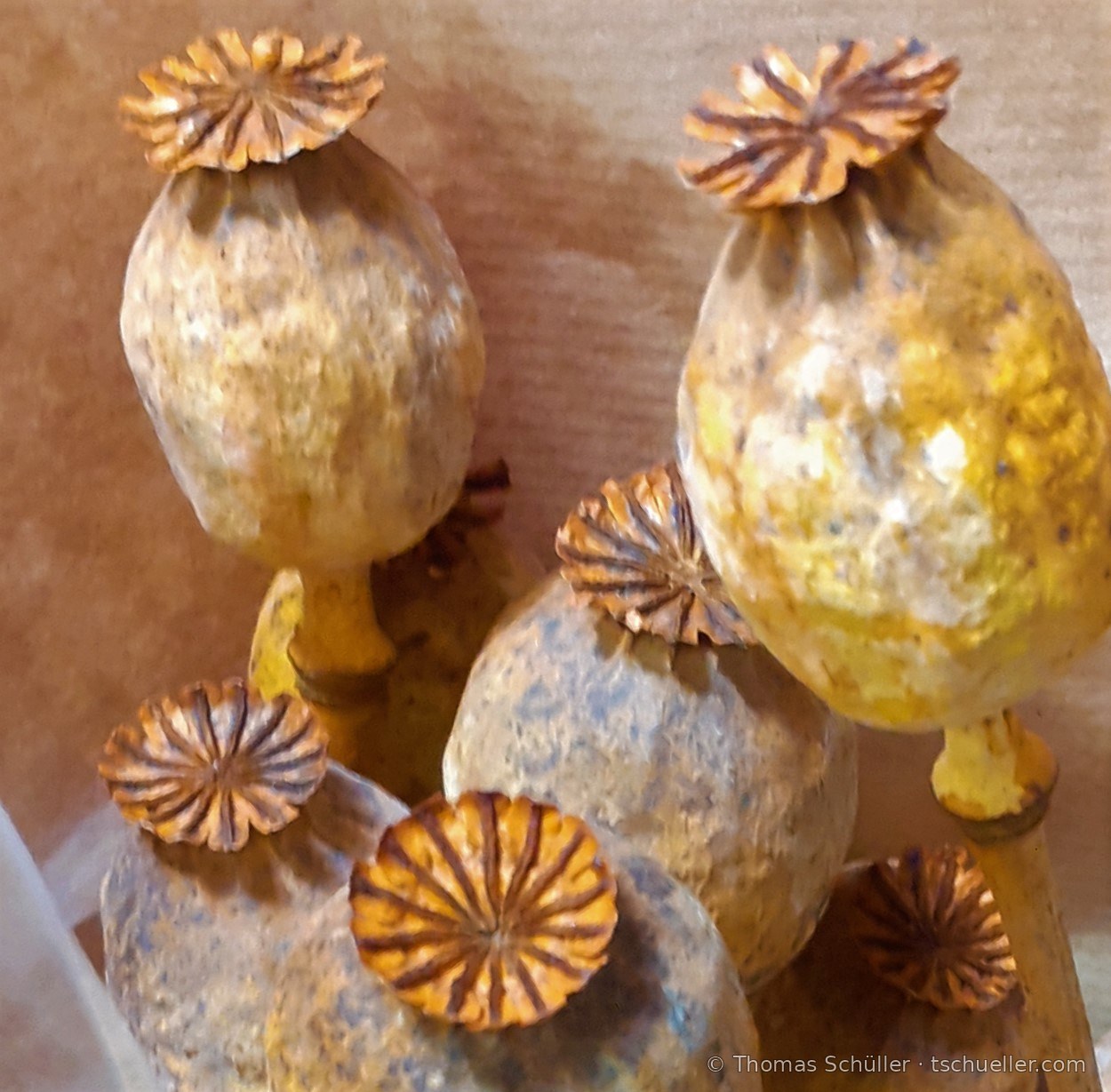
Dried seed capsules of poppy. The disc on top is the stigma; its rays show how many carpels fused to form the capsule. When ripe, small pores open beneath it through which the seed is scattered — the poppy as a pepper pot. Location not documented.
Getrocknete Fruchtkapseln des Mohns. Die Scheibe obenauf ist die Narbe; ihre Strahlen zeigen, aus wie vielen Fruchtblättern die Kapsel verwachsen ist. Reif öffnen sich darunter kleine Poren, durch die der Samen ausgestreut wird — der Mohn als Streubüchse. Ort nicht dokumentiert.
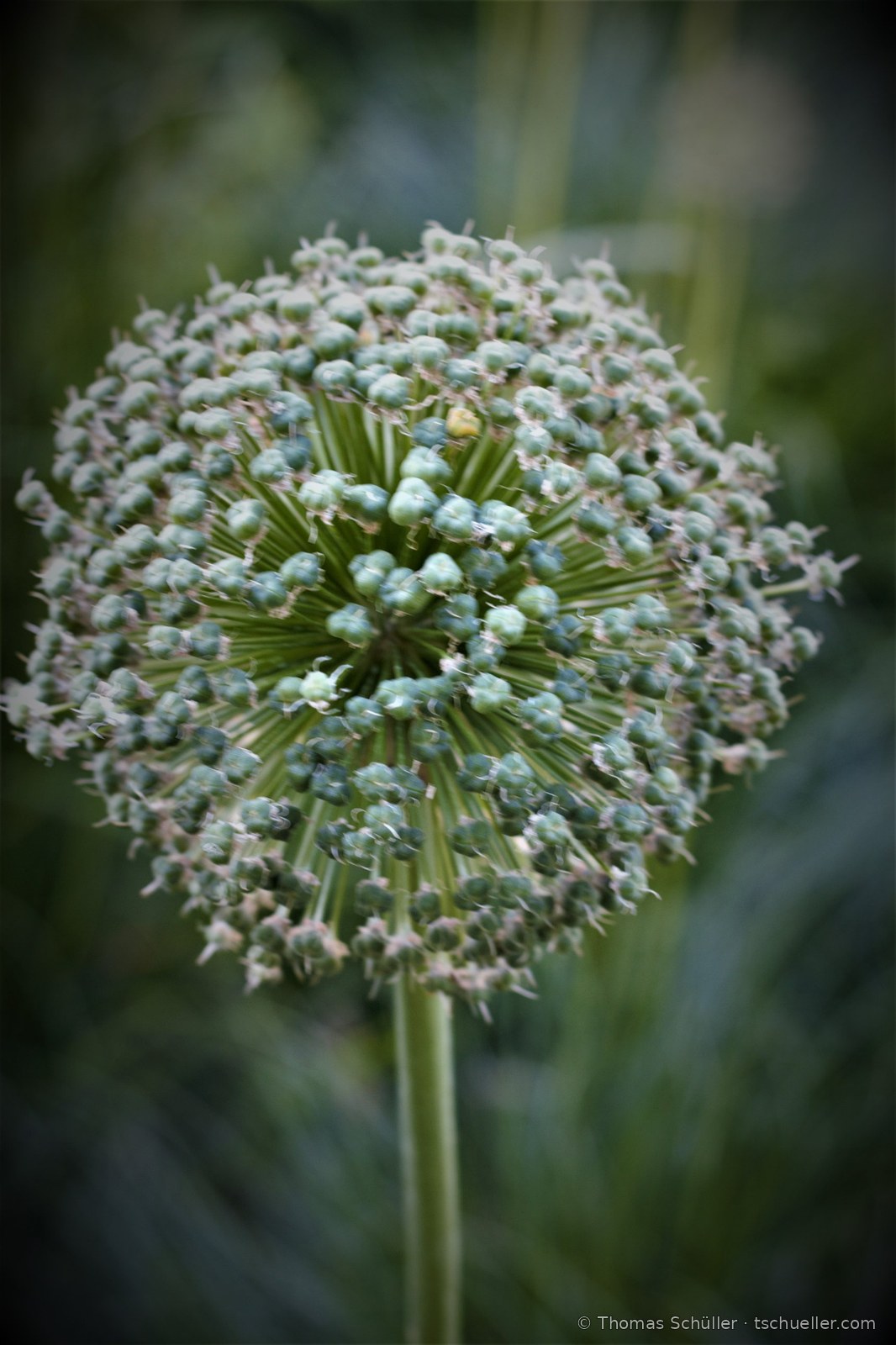
An allium head after flowering: hundreds of single flowers on stalks of equal length form a ball — an umbel. Each green knob is a three-chambered ovary that will become a seed capsule. Location not documented.
Ein Lauch nach der Blüte: Hunderte Einzelblüten auf gleich langen Stielen bilden eine Kugel — eine Dolde. Jedes grüne Knöpfchen ist ein dreifächeriger Fruchtknoten, aus dem eine Samenkapsel wird. Ort nicht dokumentiert.
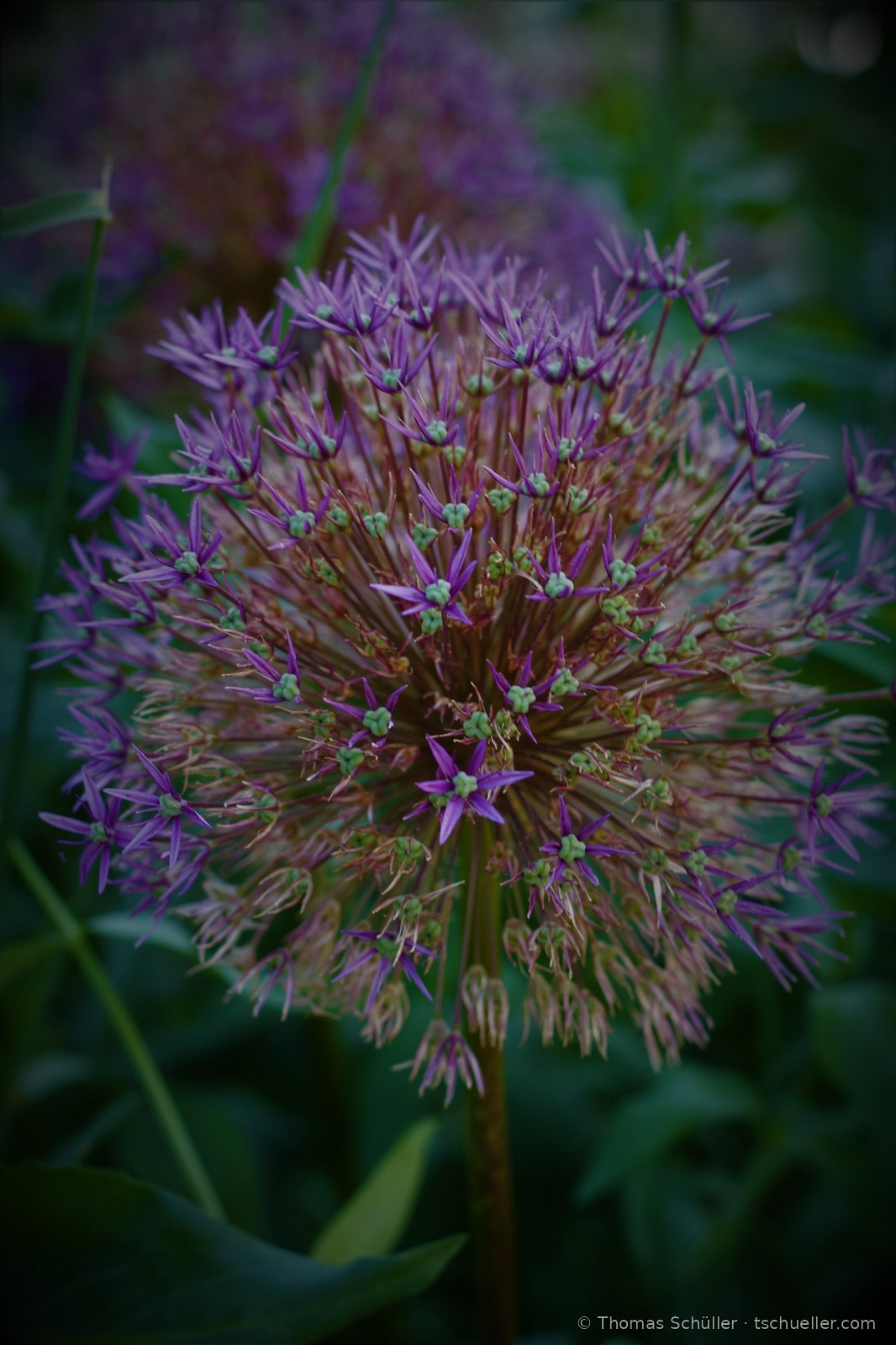
Ornamental allium in late bloom: the star-shaped tepals are still violet, while in the centre the green ovaries are already swelling. Flowering and fruiting happen in the same ball. Location not documented.
Zierlauch in später Blüte: die sternförmigen Blütenblätter sind noch violett, in der Mitte schwellen schon die grünen Fruchtknoten an. Blühen und Fruchten geschehen in derselben Kugel. Ort nicht dokumentiert.
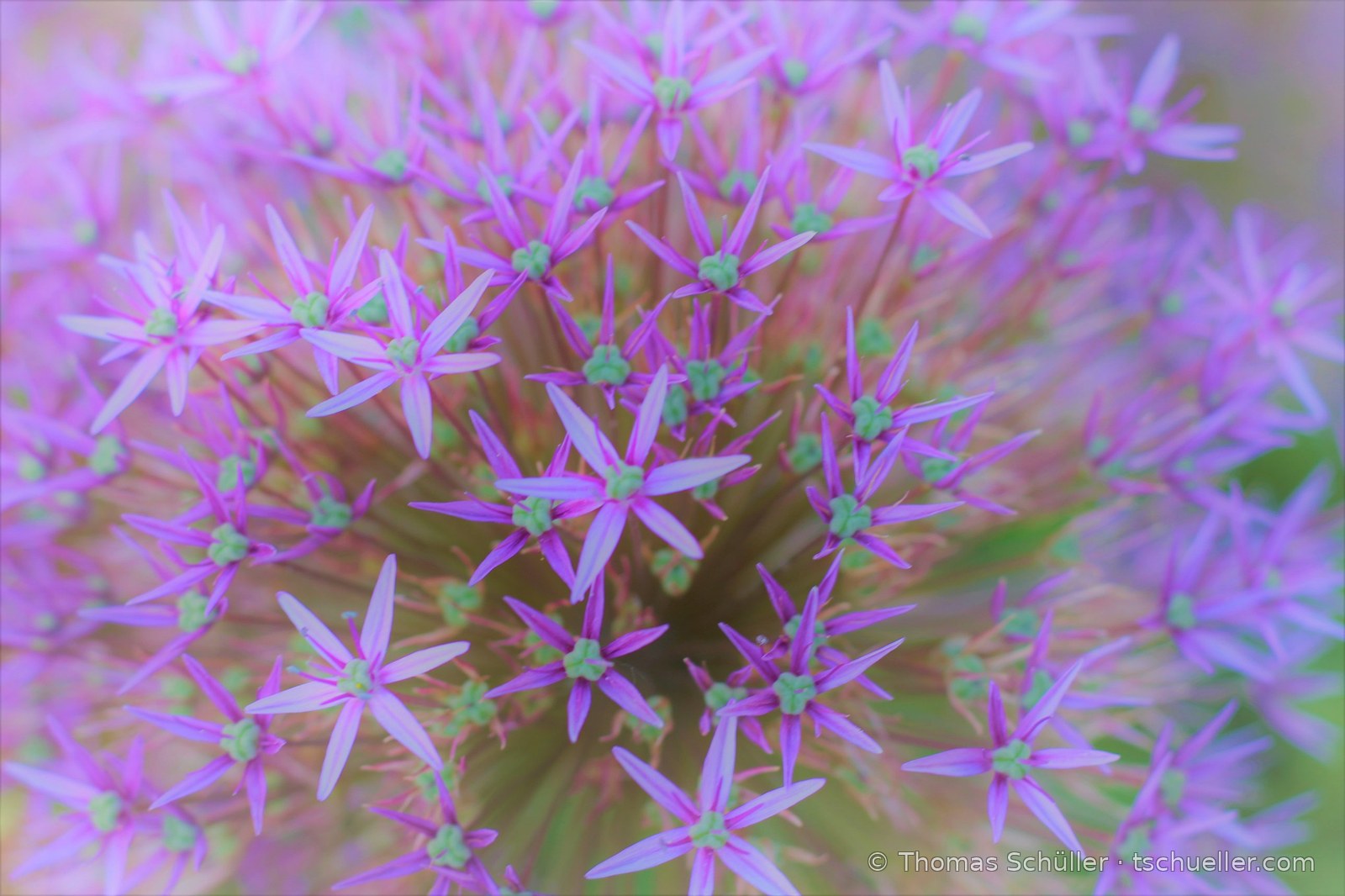
Close up, the ball breaks into single stars: six tepals each, a green ovary in the middle, the stamens around it. Location not documented.
Von nah zerfällt die Kugel in einzelne Sterne: je sechs Blütenblätter, in der Mitte der grüne Fruchtknoten, rundherum die Staubblätter. Ort nicht dokumentiert.
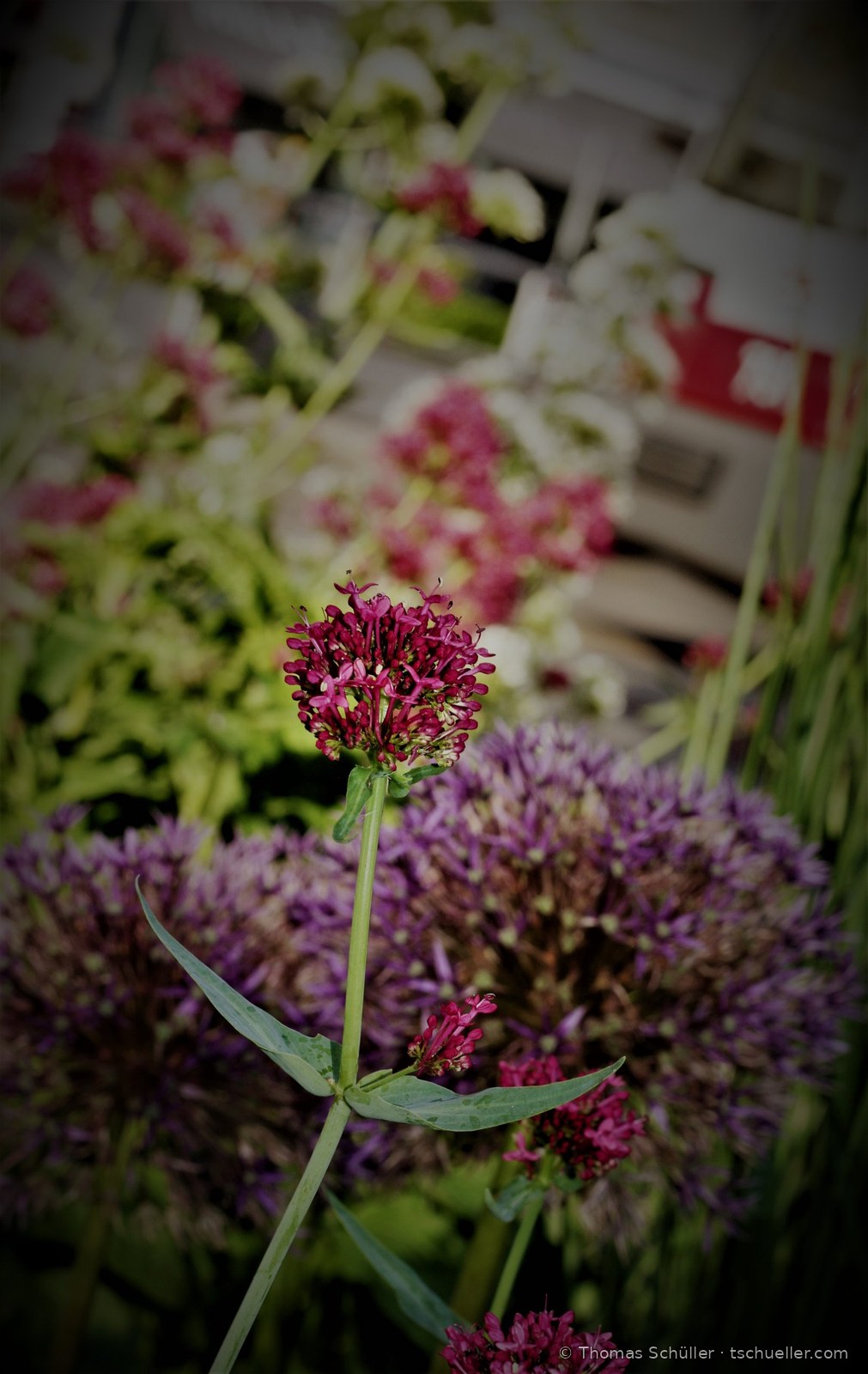
Red valerian in front of ornamental allium. Each tiny flower carries a thin spur holding nectar that only long-tongued insects such as moths and butterflies can reach. Location not documented.
Spornblume vor Zierlauch. Jede der kleinen Blüten trägt einen dünnen Sporn mit Nektar, an den nur langrüsselige Insekten wie Falter herankommen. Ort nicht dokumentiert.
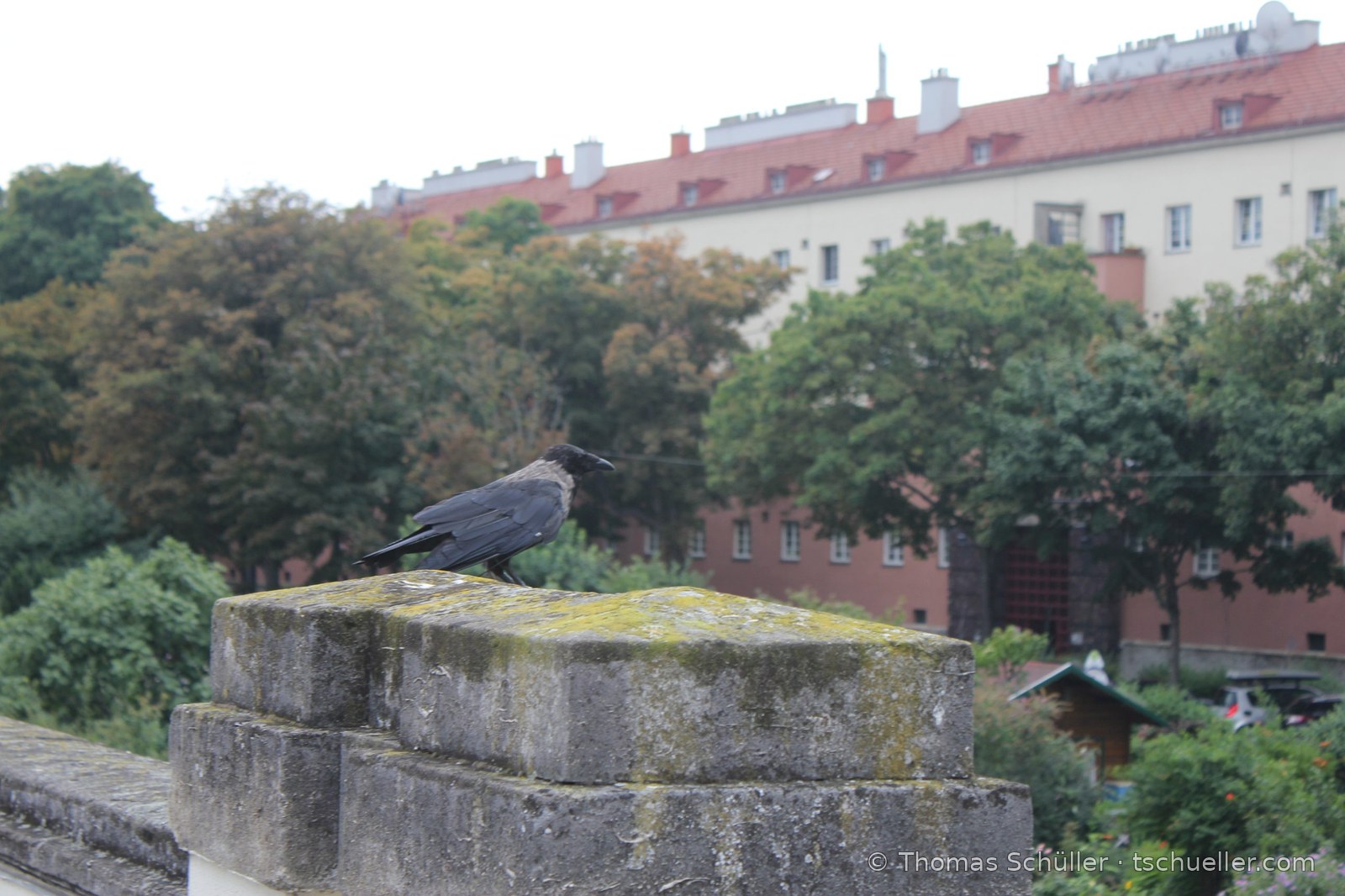
A hooded crow on a mossy wall top, behind it trees and a large housing block. Hooded crows are the typical crows of eastern Austria and Vienna; west of a line through Central Europe the all-black carrion crow takes over, and where both meet they hybridise. Vienna; the exact spot is not documented.
Eine Nebelkrähe auf einer bemoosten Mauerkrone, dahinter Bäume und ein großer Wohnbau. Die Nebelkrähe ist die typische Krähe Ostösterreichs und Wiens; westlich einer Linie quer durch Mitteleuropa übernimmt die ganz schwarze Rabenkrähe, wo beide aufeinandertreffen, mischen sie sich. Wien; der genaue Ort ist nicht dokumentiert.
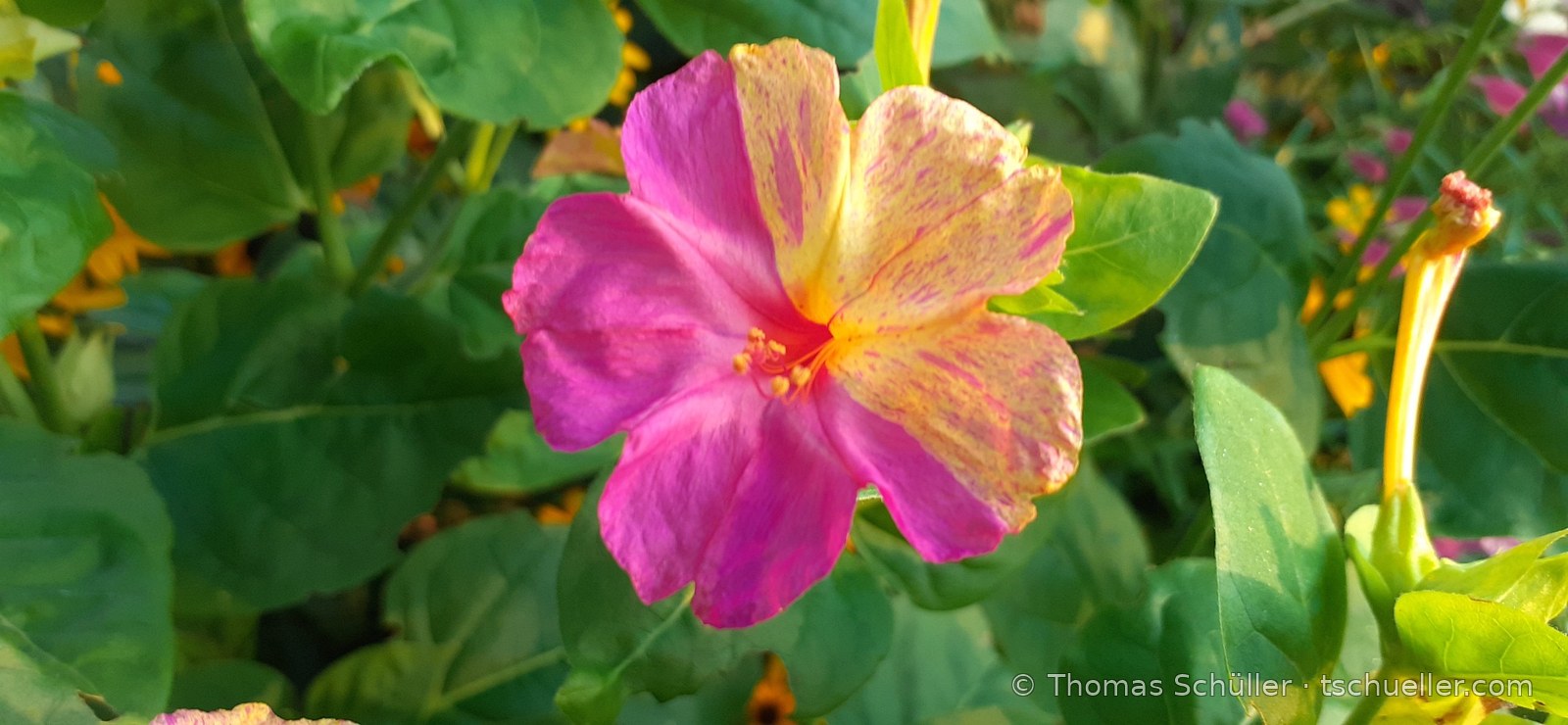
Four o’clock flower: the blooms open in the late afternoon and close again by morning. On one plant, flowers can be plain, two-coloured or streaked — here magenta on one side, yellow flecked with pink on the other. Location not documented.
Wunderblume: die Blüten öffnen sich am späten Nachmittag und schließen sich bis zum Morgen. An einer Pflanze können einfarbige, zweifarbige und gestreifte Blüten sitzen — hier eine Hälfte magenta, die andere gelb mit rosa Sprenkeln. Ort nicht dokumentiert.
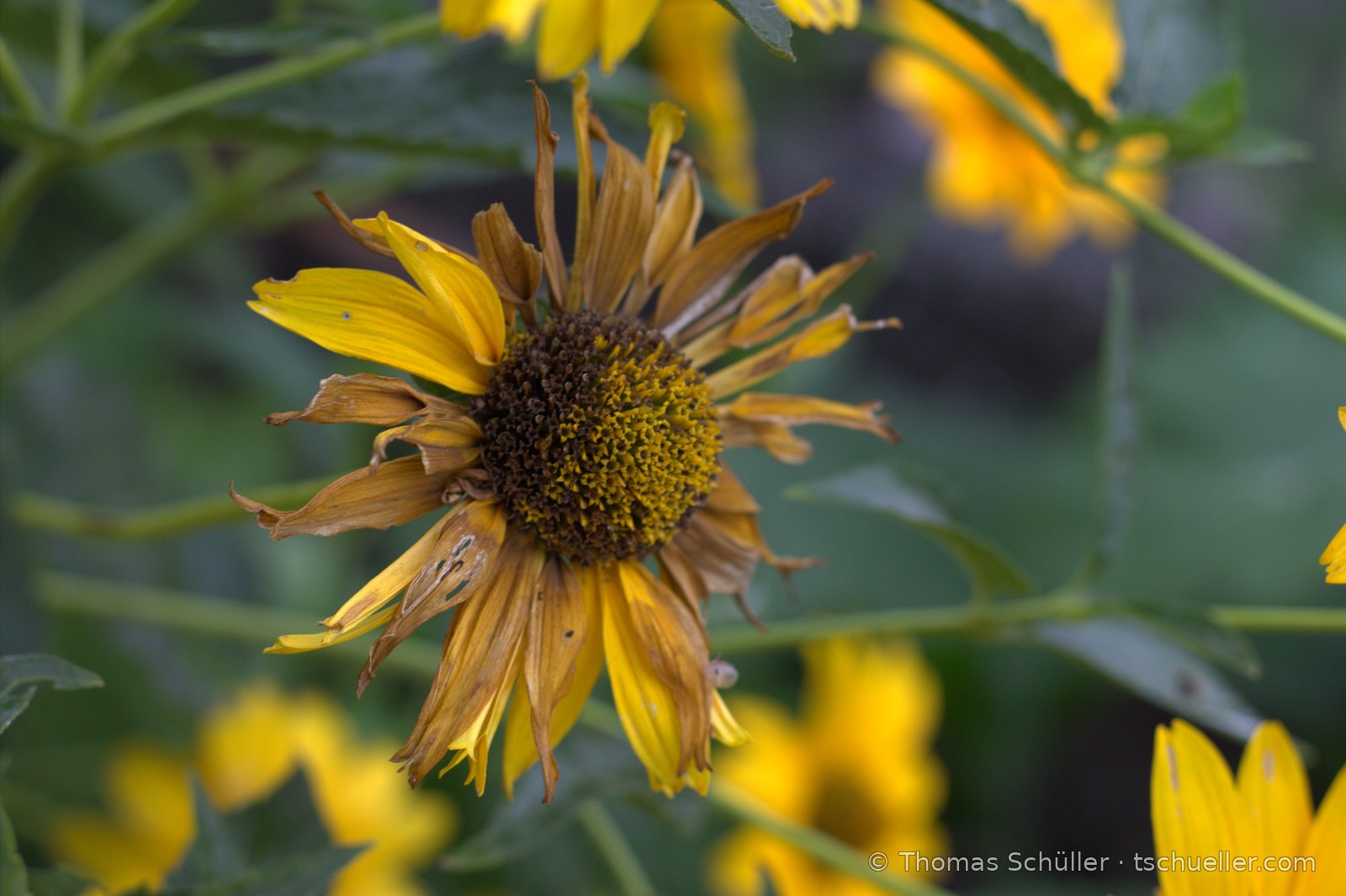
Heliopsis cf. · Sonnenauge, verblühend · 1. August 2021
A yellow composite past its peak: the ray florets are curling and browning, while the disc in the centre is setting seed. Behind it, fresh flowers of the same planting. Probably an ox-eye (Heliopsis); date from the camera, location not documented.
Ein gelber Korbblütler nach dem Höhepunkt: die Zungenblüten rollen sich ein und werden braun, in der Mitte reift der Samen. Dahinter frische Blüten derselben Pflanzung. Vermutlich ein Sonnenauge (Heliopsis); Datum aus der Kamera, Ort nicht dokumentiert.
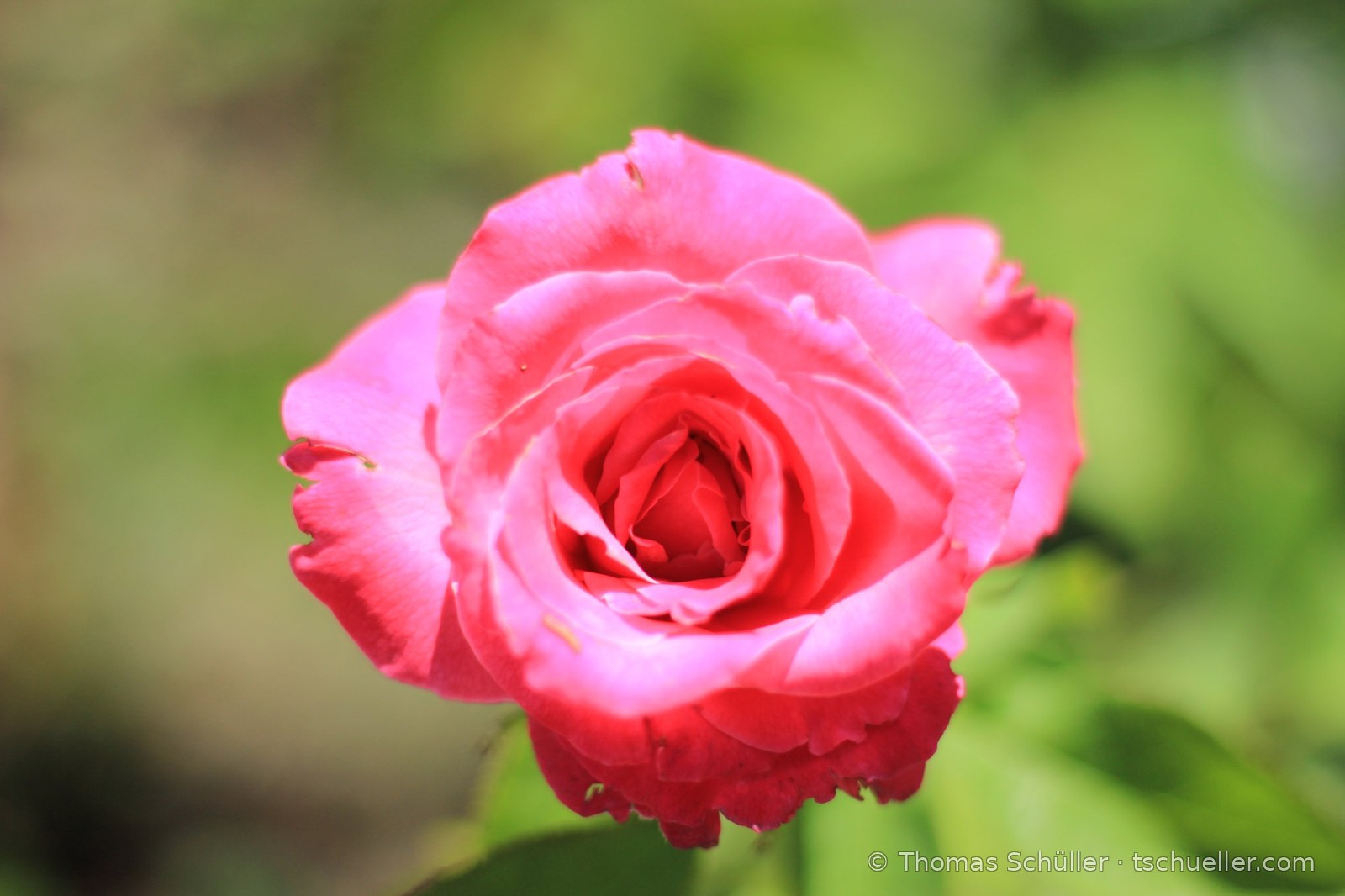
A double garden rose: the extra petals are transformed stamens, which is why the centre stays closed. The nibbled edges show who else visits the flower. Location not documented.
Eine gefüllte Gartenrose: die zusätzlichen Blütenblätter sind umgewandelte Staubblätter, darum bleibt die Mitte geschlossen. Die angefressenen Ränder zeigen, wer die Blüte sonst noch besucht. Ort nicht dokumentiert.
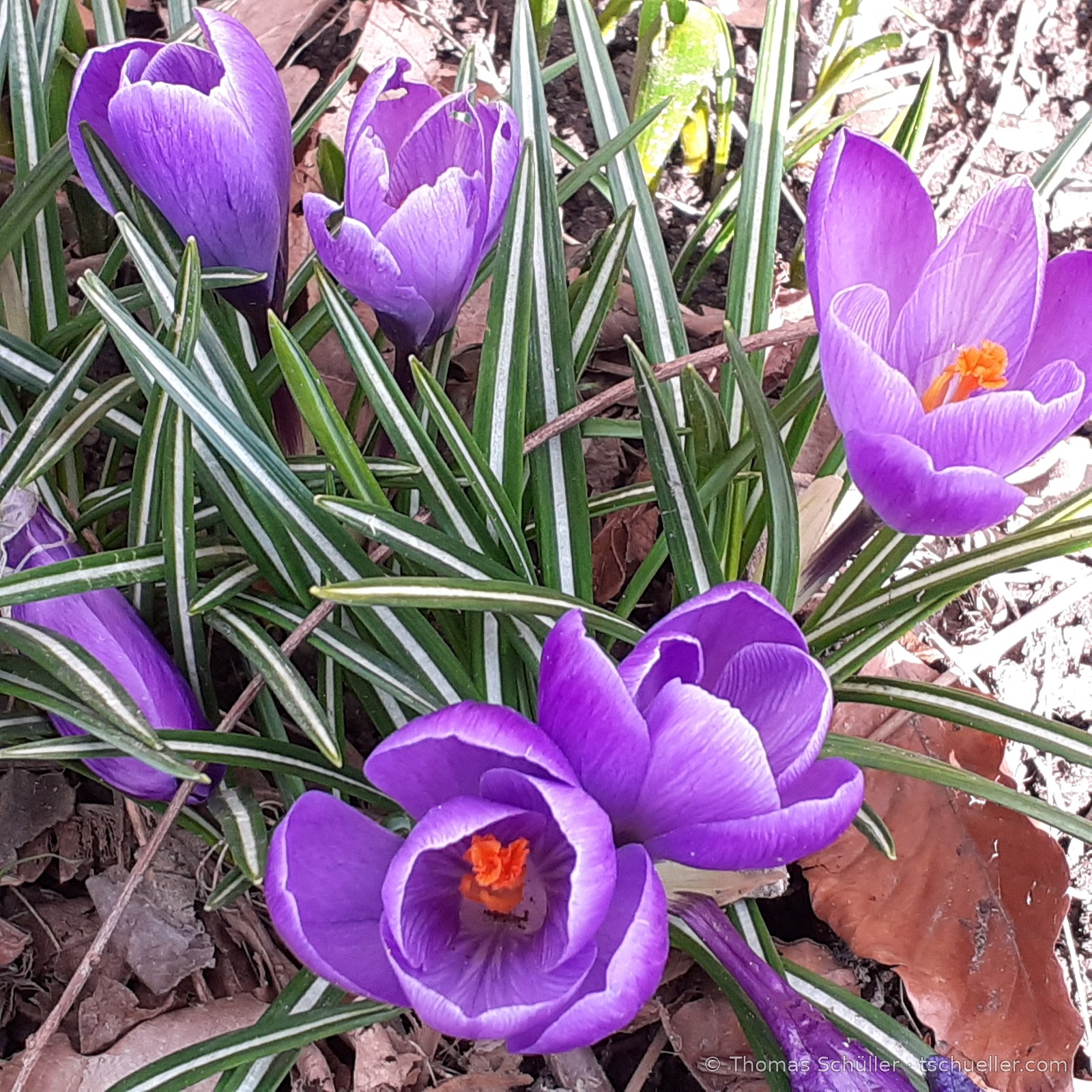
Crocuses in early spring: they flower from a corm that stores the reserves of the previous year, which is why they can bloom before the trees have leaves. The white midrib on the narrow leaves is typical of the genus. Location not documented.
Krokusse im Vorfrühling: sie blühen aus einer Knolle, die die Reserven des Vorjahres speichert, und können darum blühen, bevor die Bäume Blätter haben. Der weiße Mittelstreif auf den schmalen Blättern ist typisch für die Gattung. Ort nicht dokumentiert.
Crocus vernus cf. · gestreifte Sorte · 15. März 2021
A striped garden crocus seen from above: three outer and three inner tepals, the orange stigma in the centre. Striped forms like this are cultivated varieties. Location not documented.
Ein gestreifter Gartenkrokus von oben: drei äußere und drei innere Blütenblätter, in der Mitte die orange Narbe. Gestreifte Formen wie diese sind Zuchtsorten. Ort nicht dokumentiert.
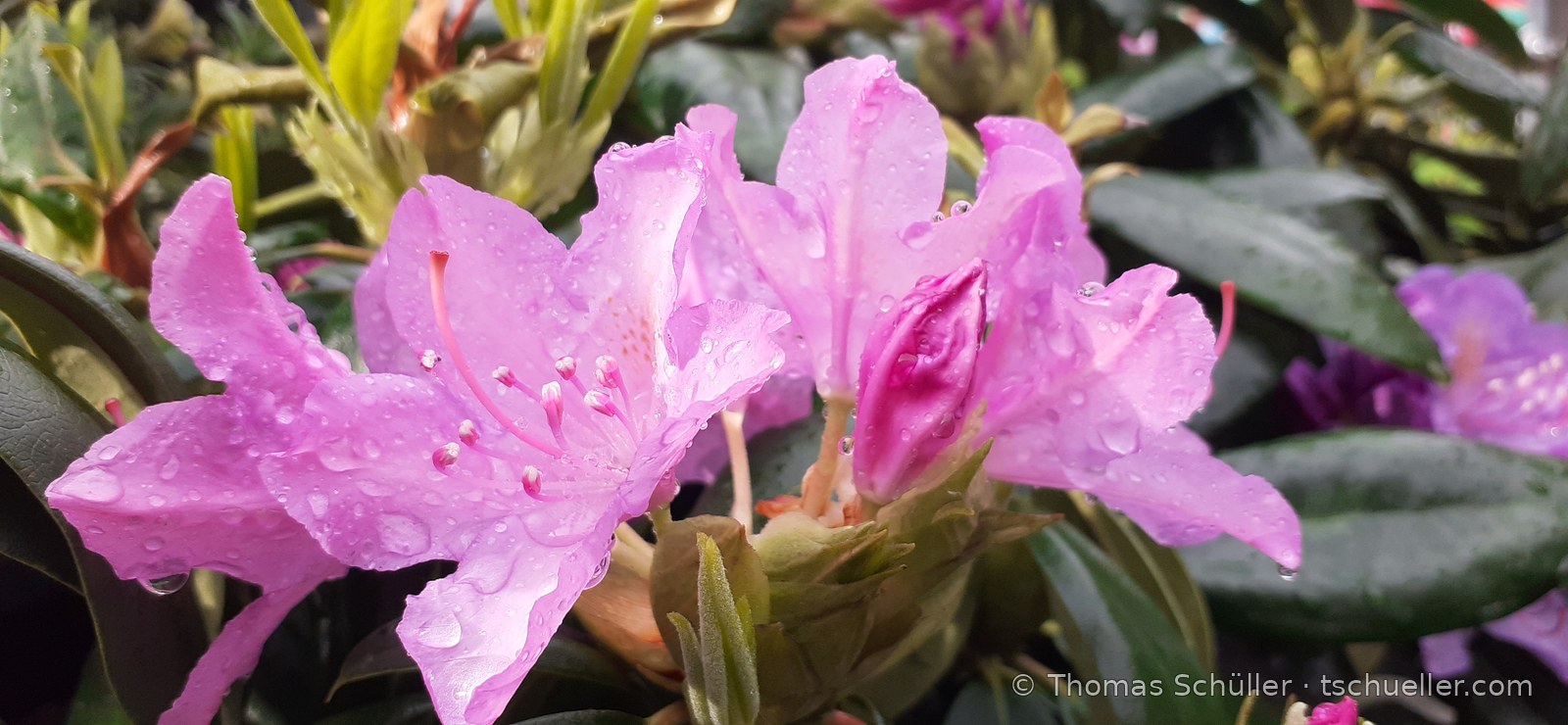
Rhododendron in flower: each truss is a cluster of funnel-shaped flowers; the darker spots on the upper petal guide insects to the nectar. Location not documented.
Rhododendron in Blüte: jeder Blütenstand ist eine Dolde aus trichterförmigen Einzelblüten; die dunkleren Flecken am oberen Blütenblatt weisen Insekten den Weg zum Nektar. Ort nicht dokumentiert.
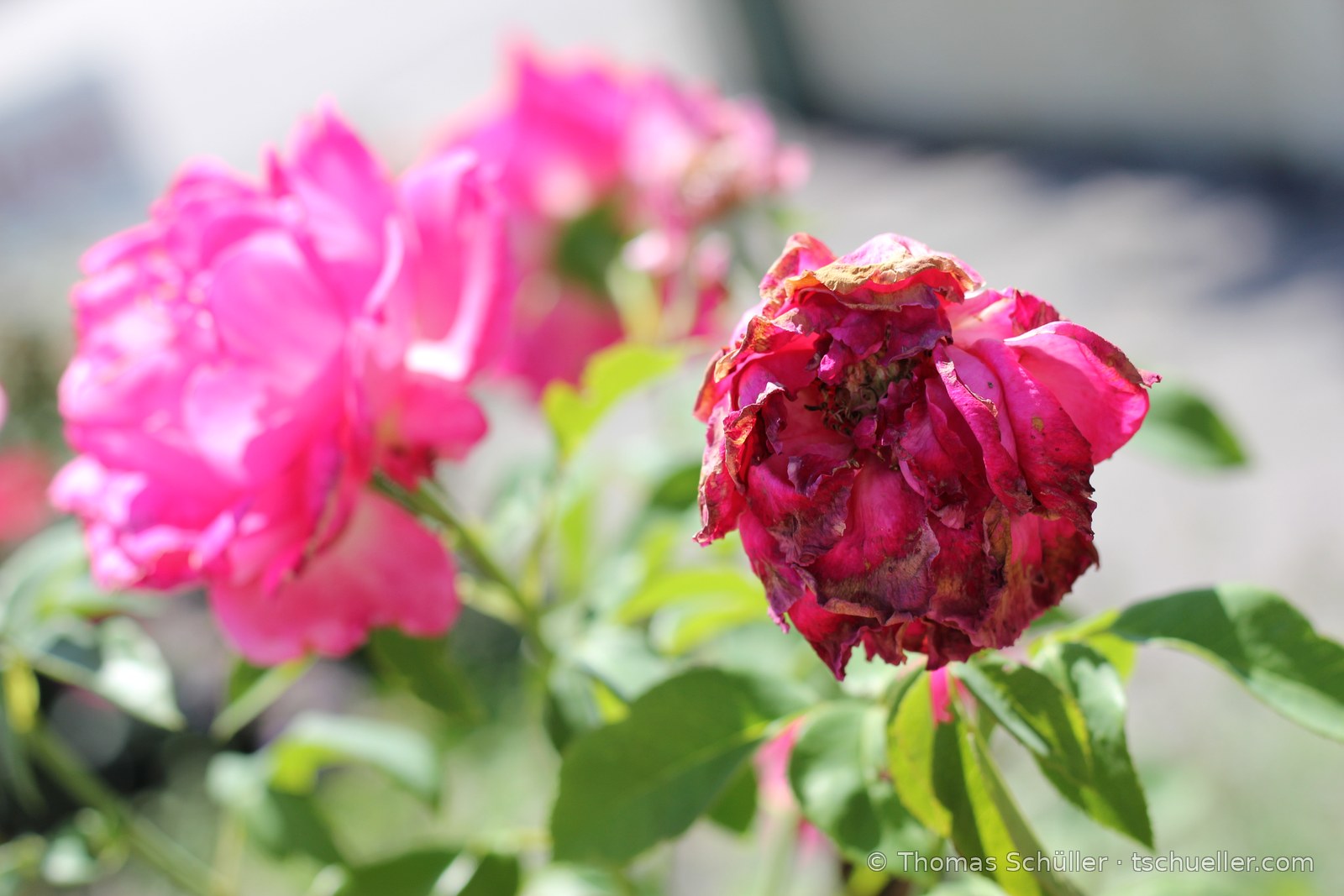
Two stages on one bush: open pink flowers next to one that has already dried dark red. Roses that are not deadheaded go on to form hips. Location not documented.
Zwei Stadien an einem Strauch: offene rosa Blüten neben einer, die schon dunkelrot vertrocknet ist. Rosen, die man nicht ausschneidet, bilden danach Hagebutten. Ort nicht dokumentiert.
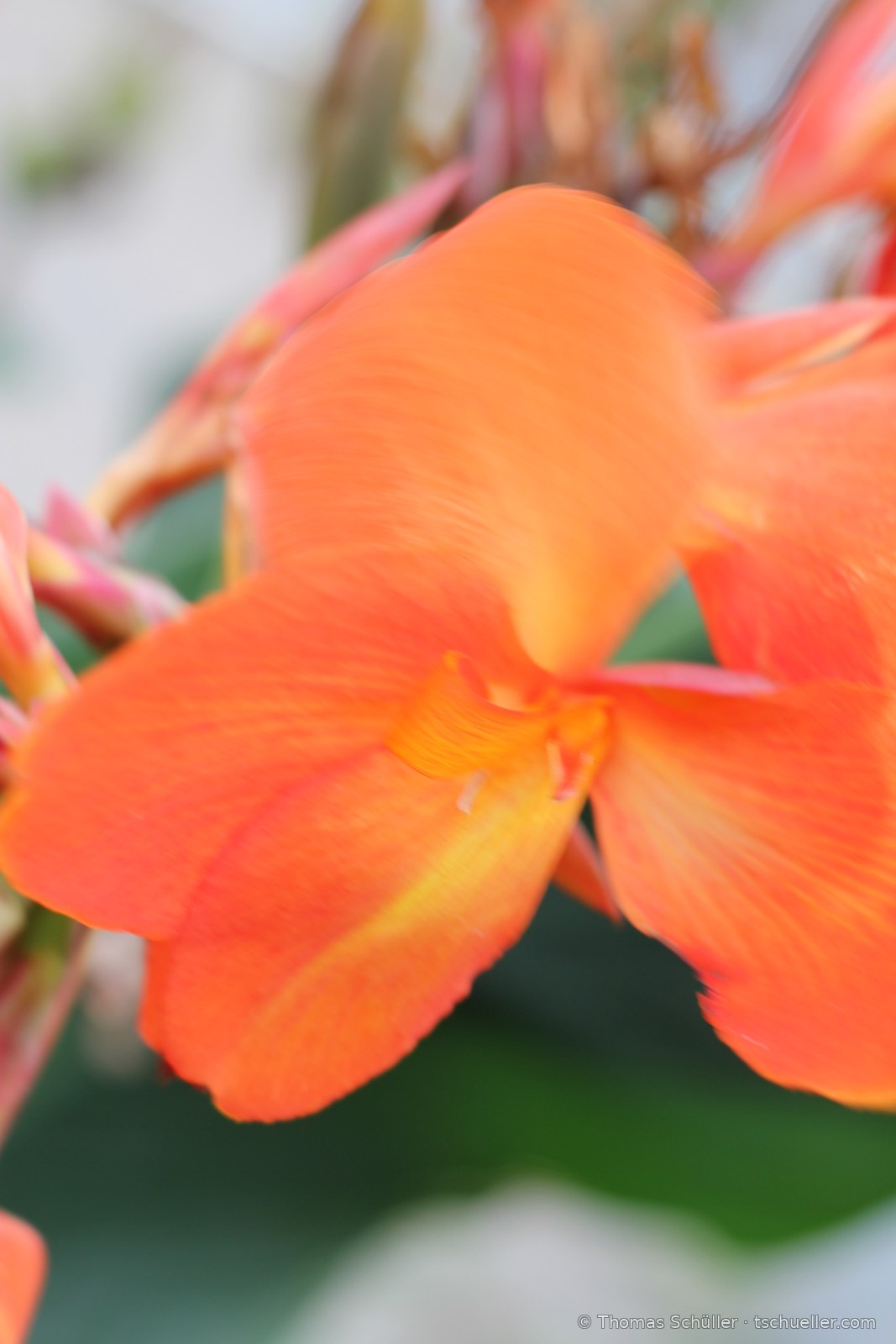
Canna in autumn: what look like petals are mostly transformed stamens; only one of them still carries pollen. Location not documented.
Blumenrohr im Herbst: was wie Blütenblätter aussieht, sind großteils umgewandelte Staubblätter; nur eines davon trägt noch Pollen. Ort nicht dokumentiert.
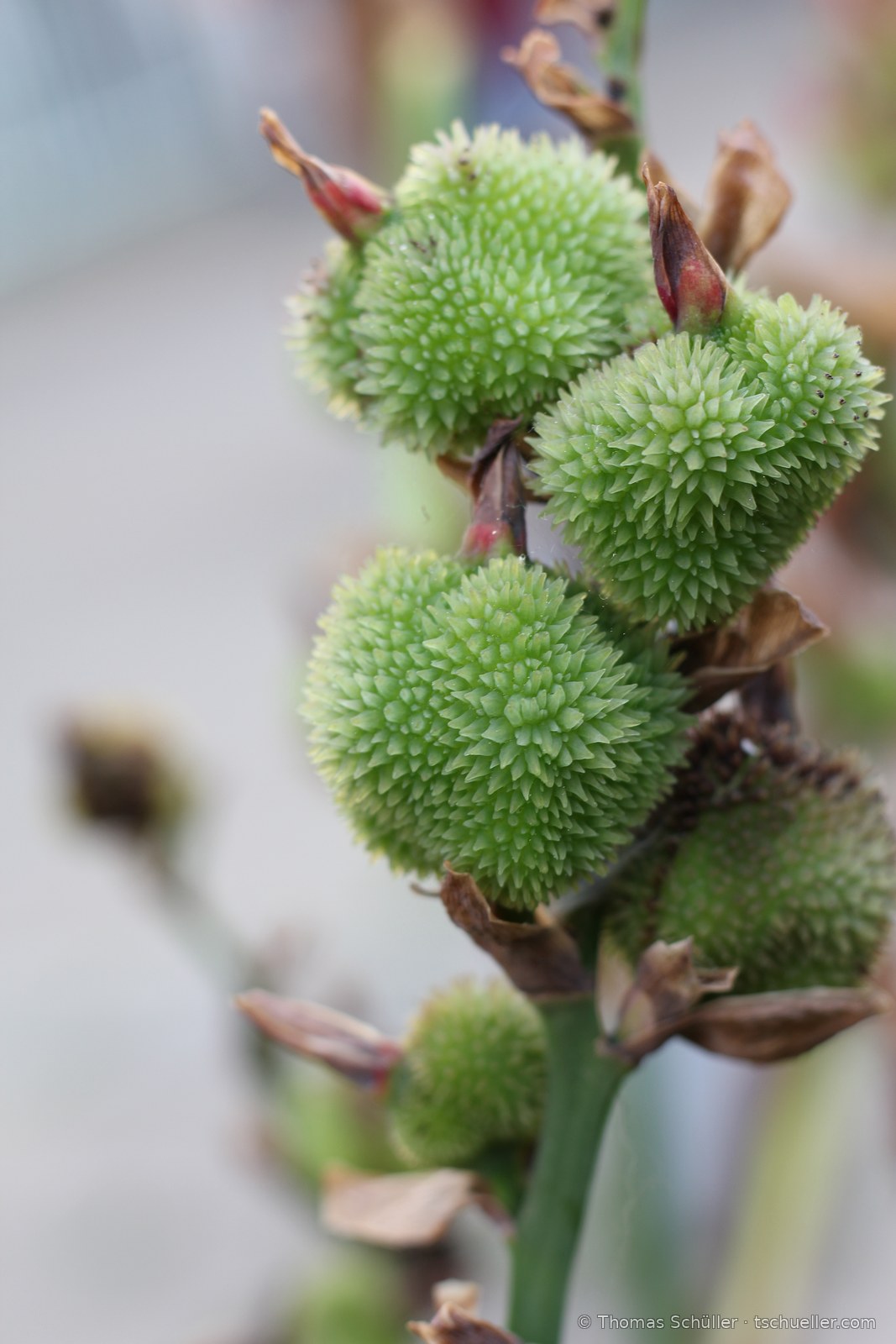
The same plant a few flowers further on: soft-spined capsules with round black seeds inside, so hard that they were once used as shot — hence the English name Indian shot. Location not documented.
Dieselbe Pflanze ein paar Blüten weiter: weichstachelige Kapseln, darin runde schwarze Samen, so hart, dass man sie früher als Schrot verwendete. Ort nicht dokumentiert.
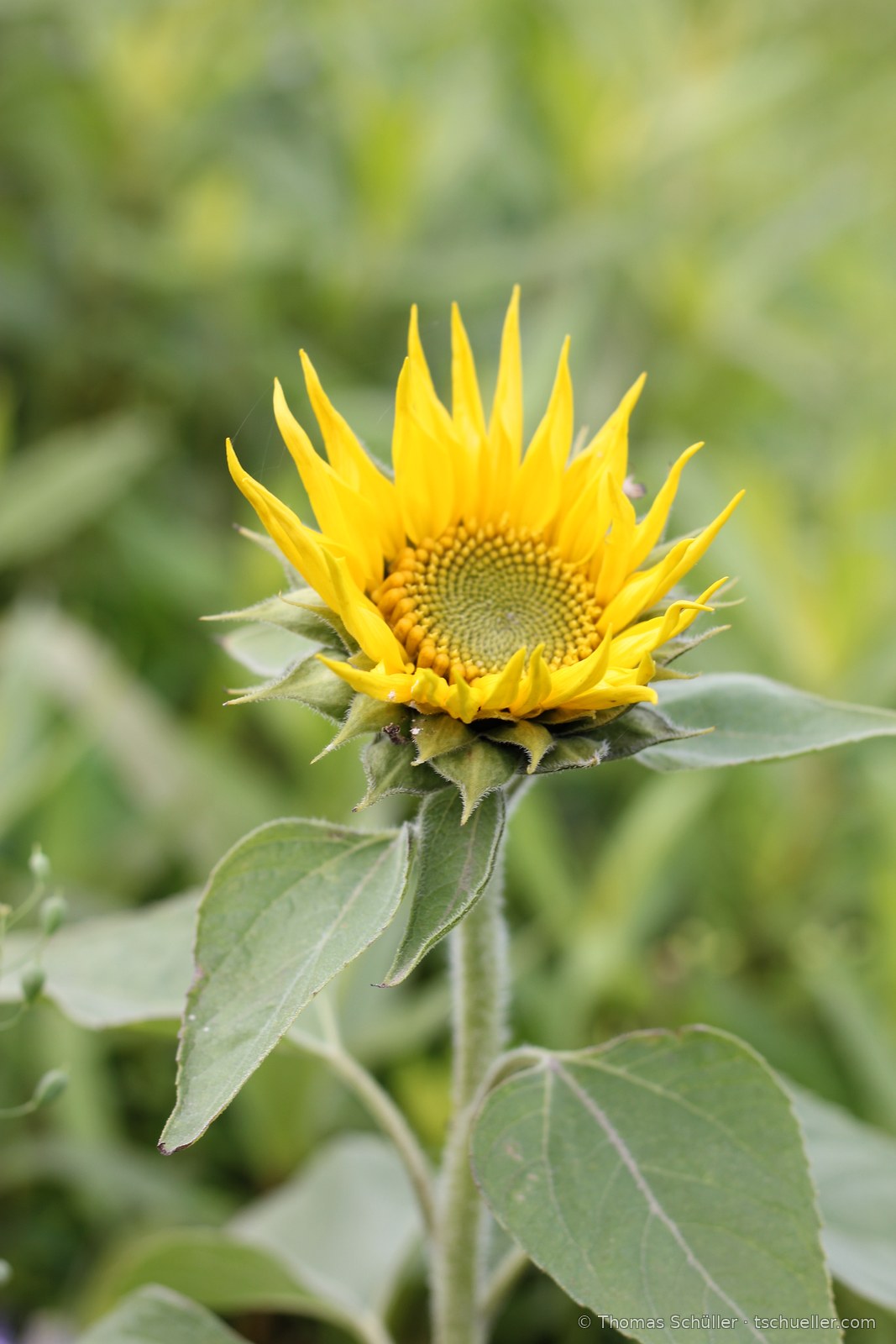
Helianthus annuus · Sonnenblume · 21. Oktober 2020
A young sunflower in late October, the disc still closed. Flowering this late suggests a sowing as catch crop or flower strip after the main harvest. Location not documented.
Eine junge Sonnenblume Ende Oktober, die Scheibe noch geschlossen. So späte Blüte spricht für eine Aussaat als Zwischenfrucht oder Blühstreifen nach der Haupternte. Ort nicht dokumentiert.
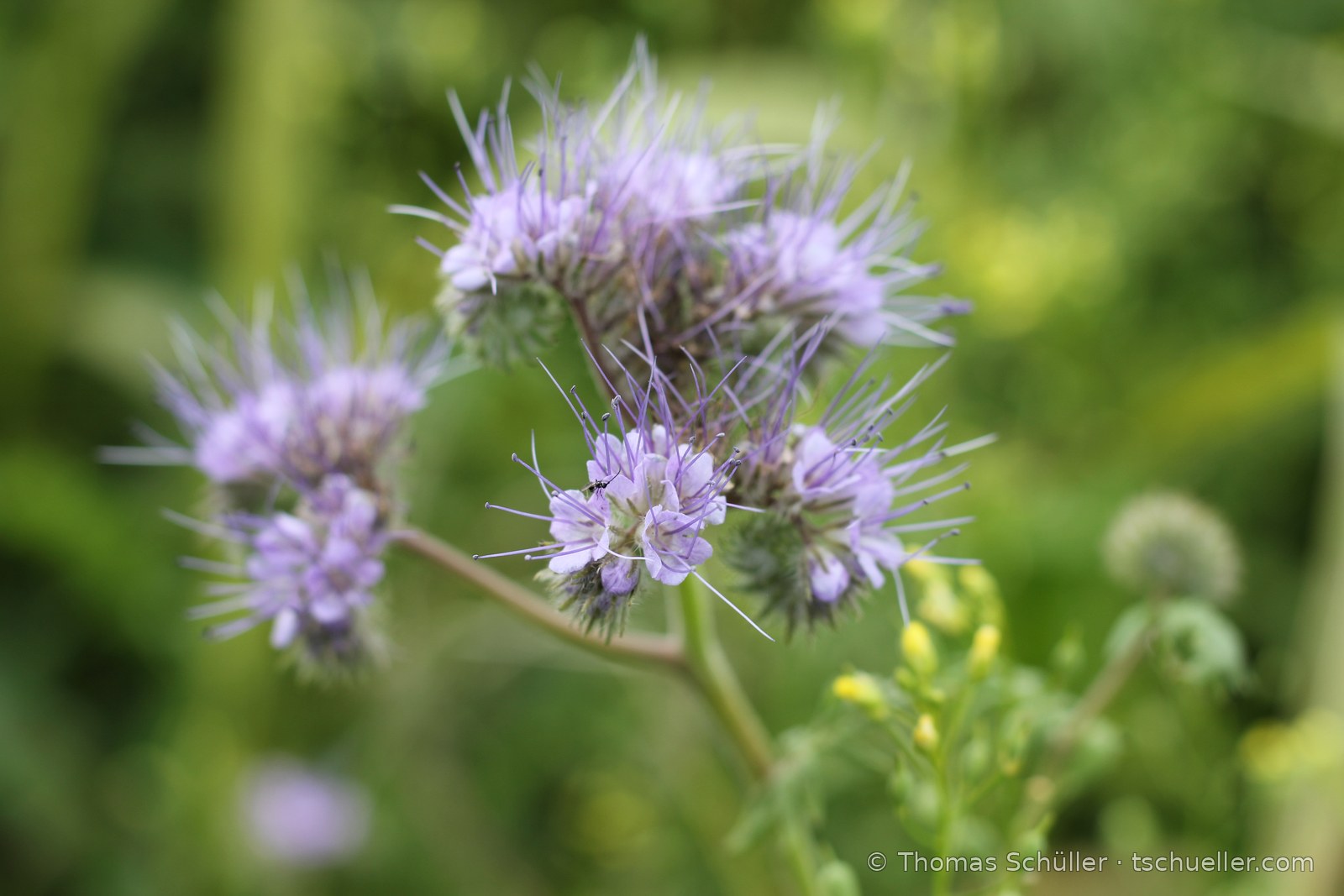
Phacelia tanacetifolia · Bienenfreund · 21. Oktober 2020
Phacelia, sown as green manure and bee pasture: the flowers open one after another along a coiled stalk that slowly unrolls. Location not documented.
Phacelia, als Gründüngung und Bienenweide gesät: die Blüten öffnen nacheinander an einem eingerollten Stiel, der sich langsam aufrollt. Ort nicht dokumentiert.
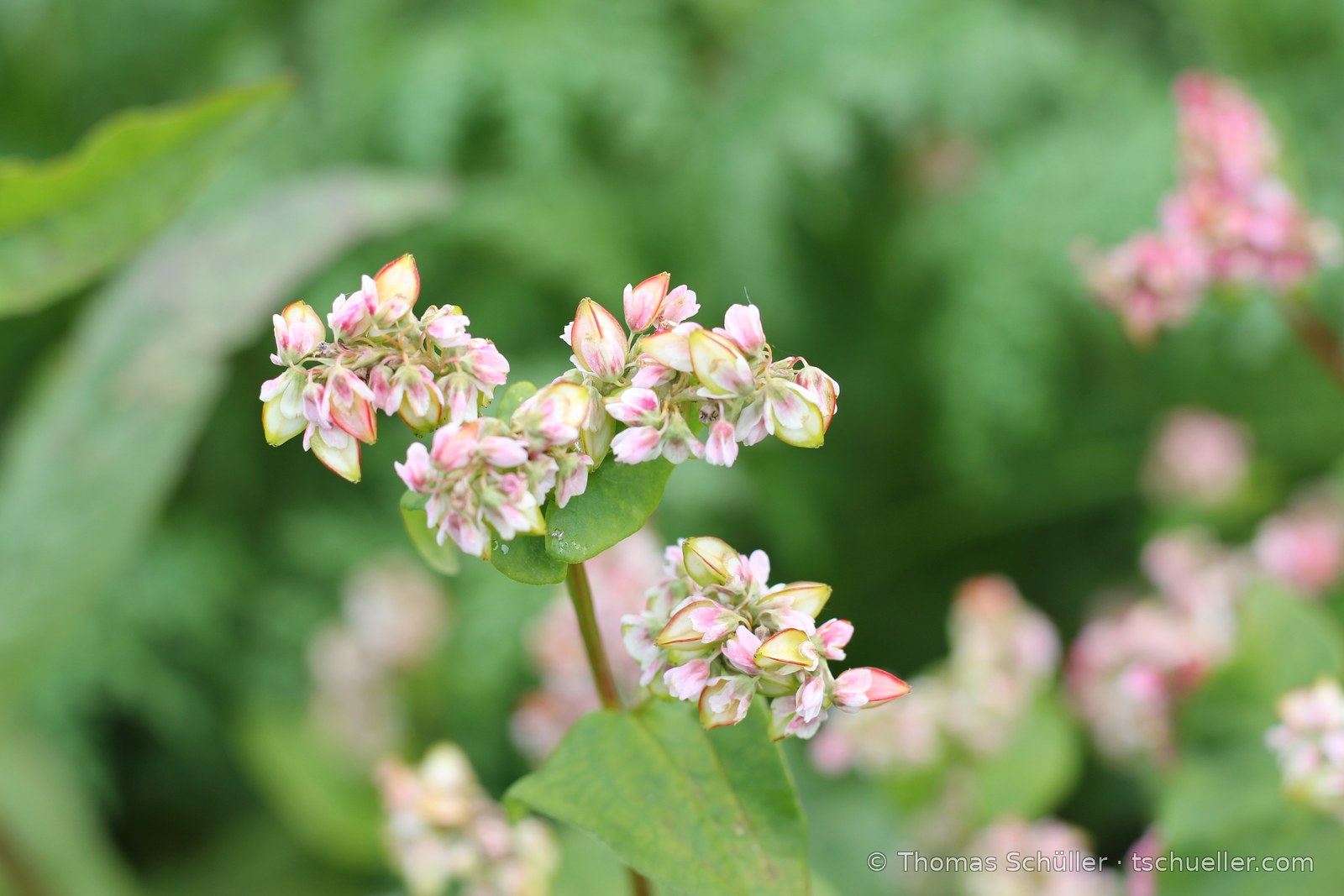
Fagopyrum esculentum · Buchweizen · 21. Oktober 2020
Buckwheat in flower — not a grass but a knotweed relative. Its seeds are eaten like grain; in autumn it often stands in catch-crop mixtures. Location not documented.
Buchweizen in Blüte — kein Getreide, sondern ein Knöterichgewächs. Die Samen isst man wie Korn; im Herbst steht er oft in Zwischenfrucht-Mischungen. Ort nicht dokumentiert.
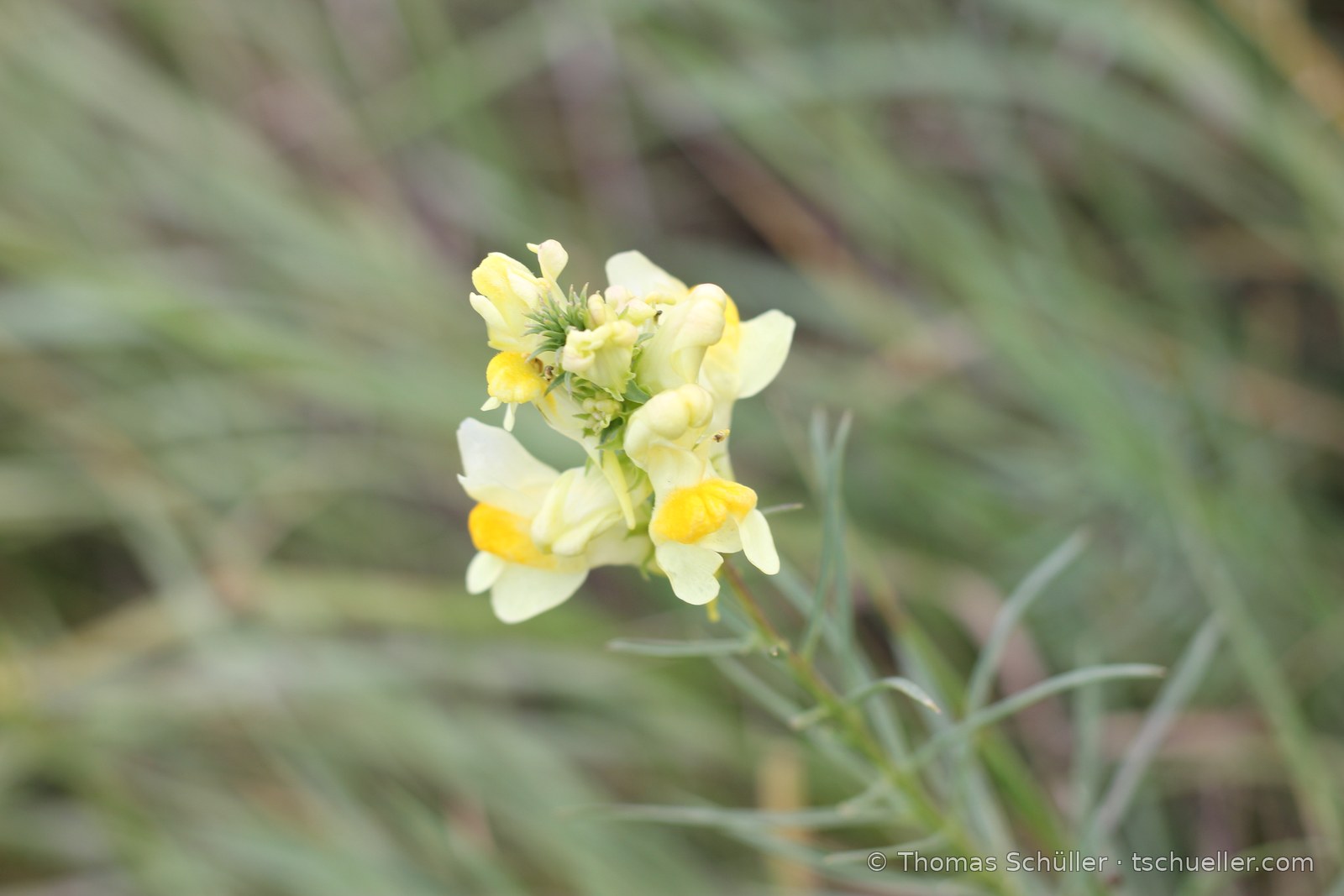
Linaria vulgaris cf. · Leinkraut · 21. Oktober 2020
Toadflax: the flower is closed by a bulging lower lip; only bumblebees are strong enough to push it open and reach the nectar in the spur. Location not documented.
Leinkraut: die Blüte ist durch eine gewölbte Unterlippe verschlossen; nur Hummeln sind kräftig genug, sie aufzudrücken und an den Nektar im Sporn zu kommen. Ort nicht dokumentiert.
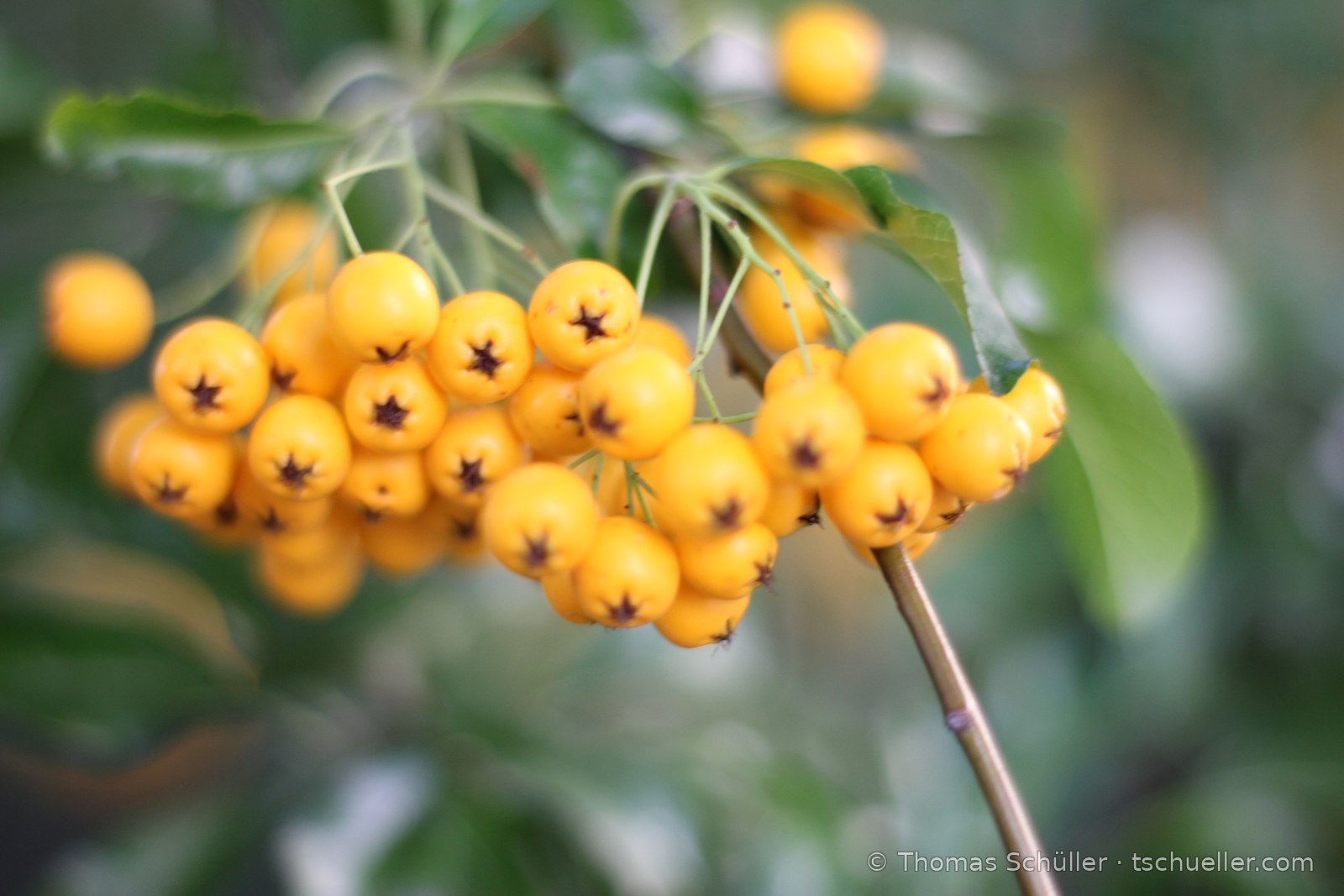
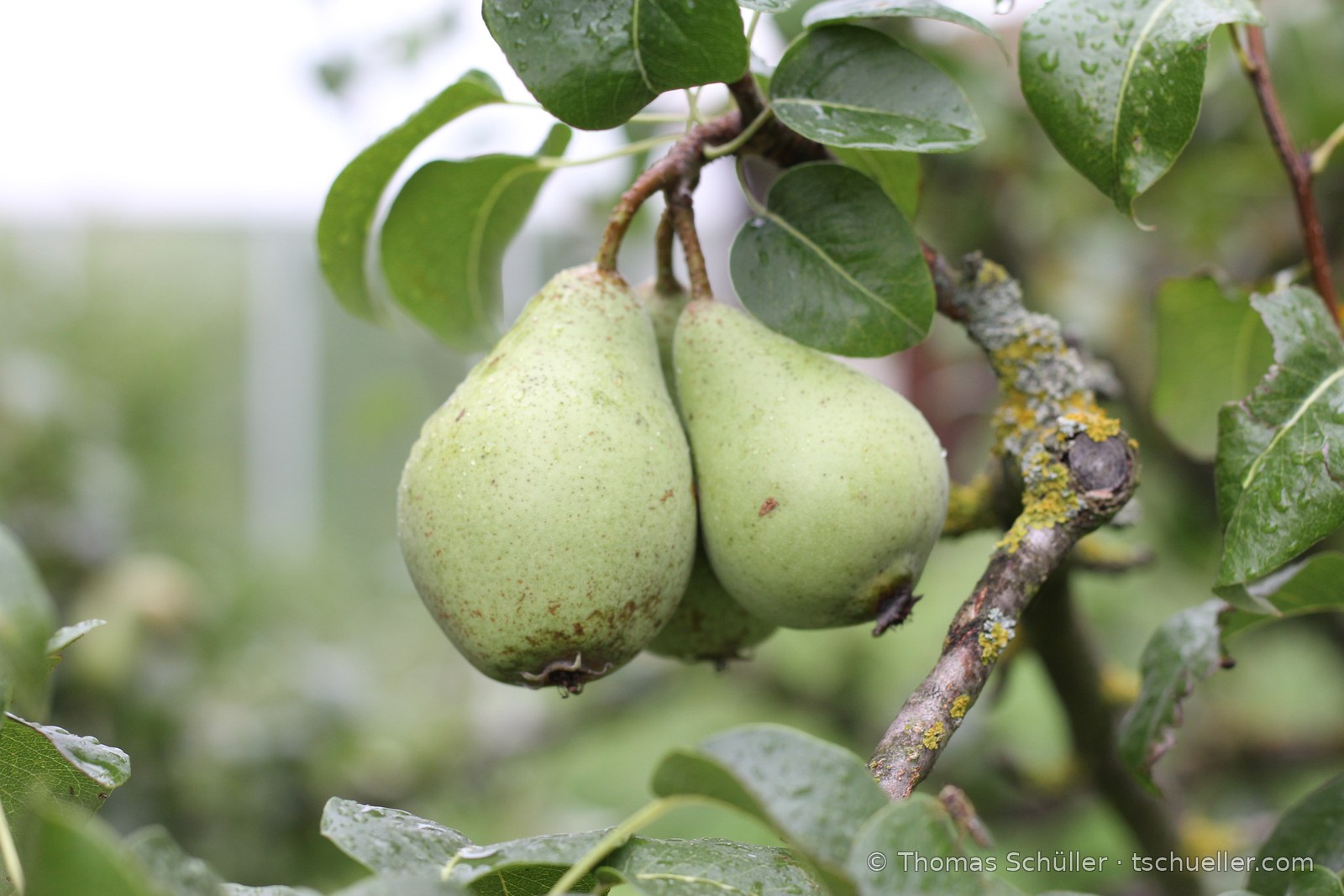
Pears ripening on the branch, still green and hard; many pear varieties are picked before full ripeness and finish ripening in storage. Location not documented.
Birnen am Zweig, noch grün und hart; viele Birnensorten werden vor der Vollreife geerntet und reifen am Lager nach. Ort nicht dokumentiert.
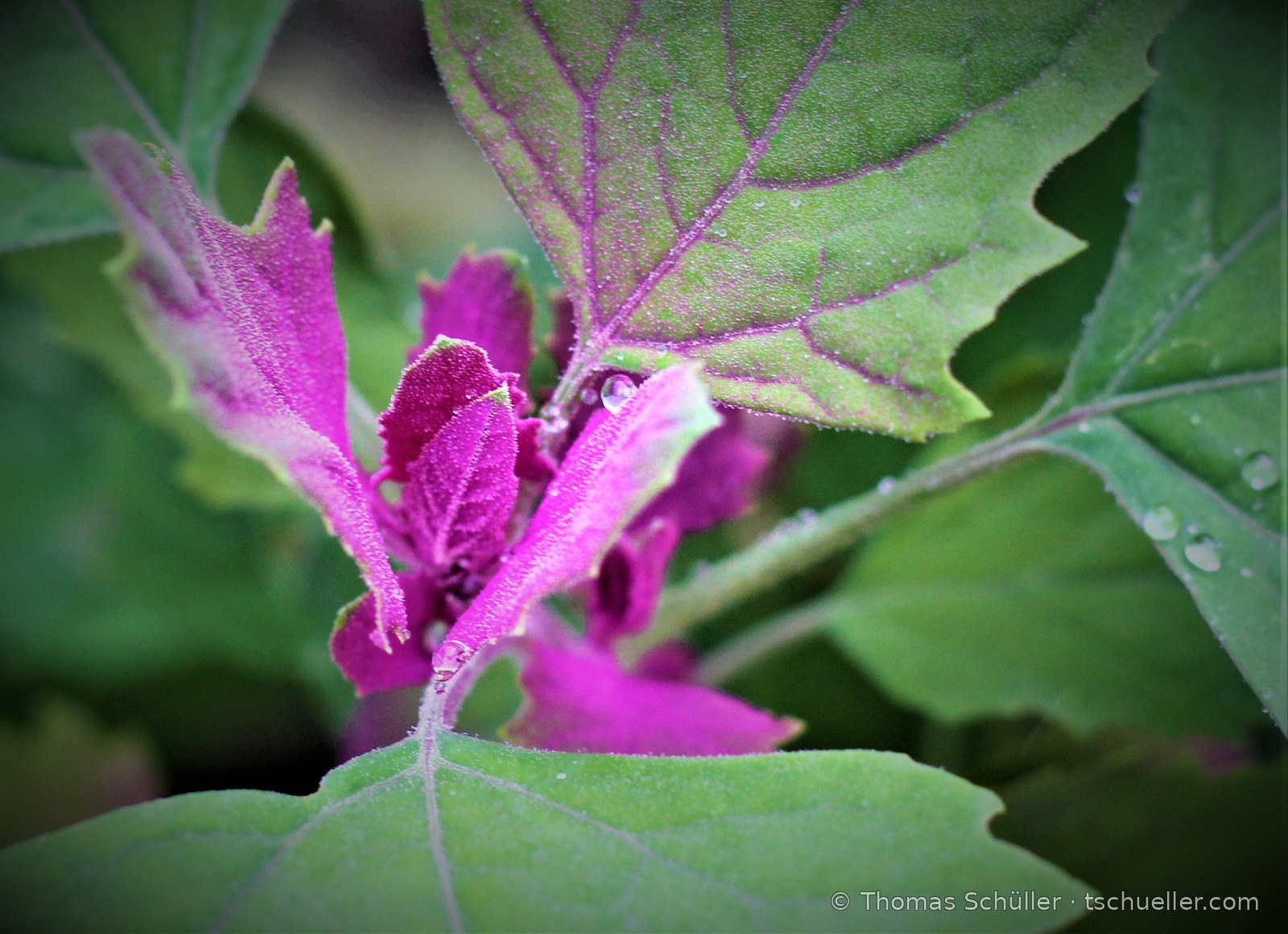
Chenopodium giganteum cf. · Baumspinat · 1. August 2021
The young shoot tips are coloured magenta by a fine coating, the older leaves turn green. The leaves are eaten like spinach. Location not documented.
Die jungen Triebspitzen sind von einem feinen Belag magenta gefärbt, die älteren Blätter werden grün. Die Blätter isst man wie Spinat. Ort nicht dokumentiert.
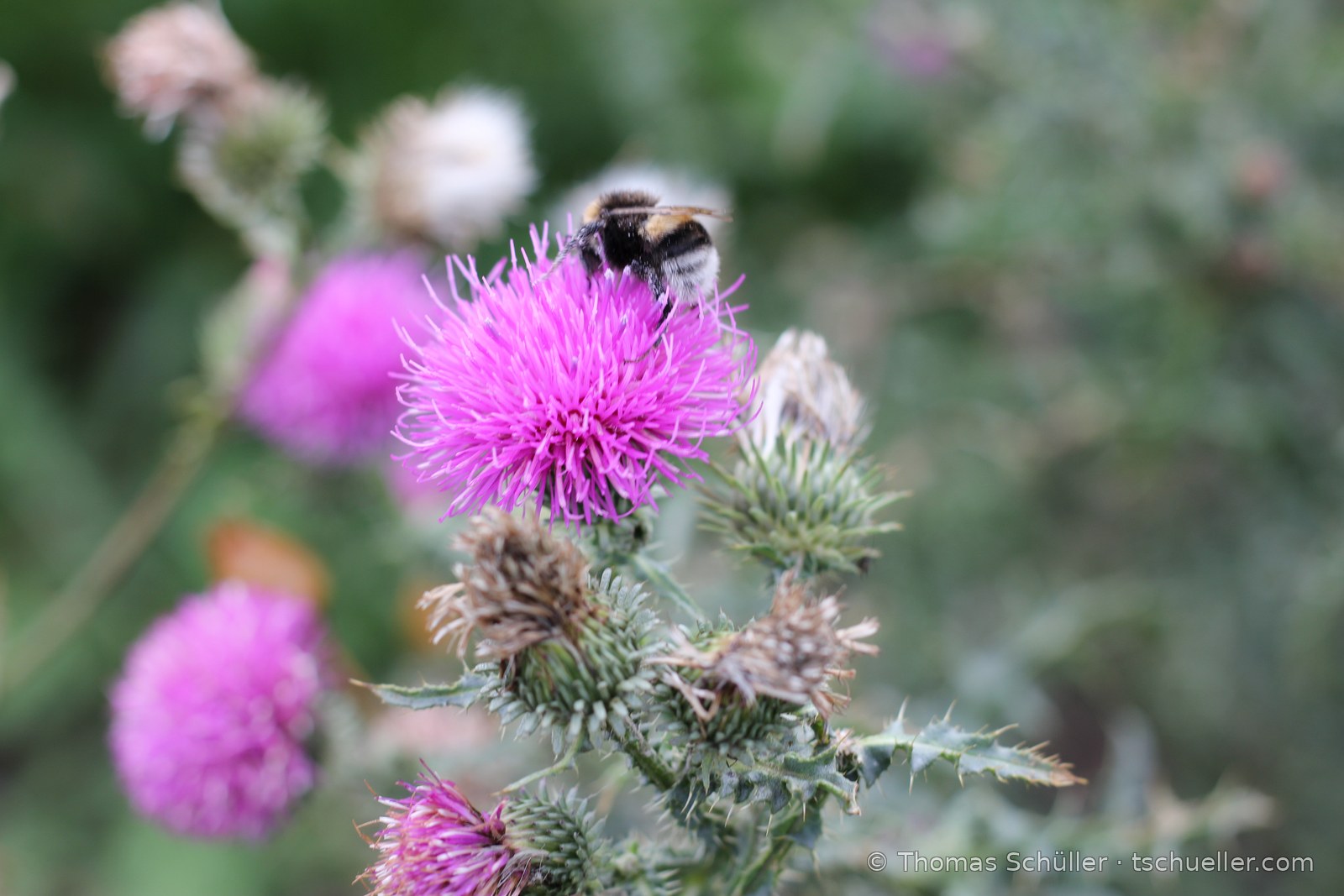
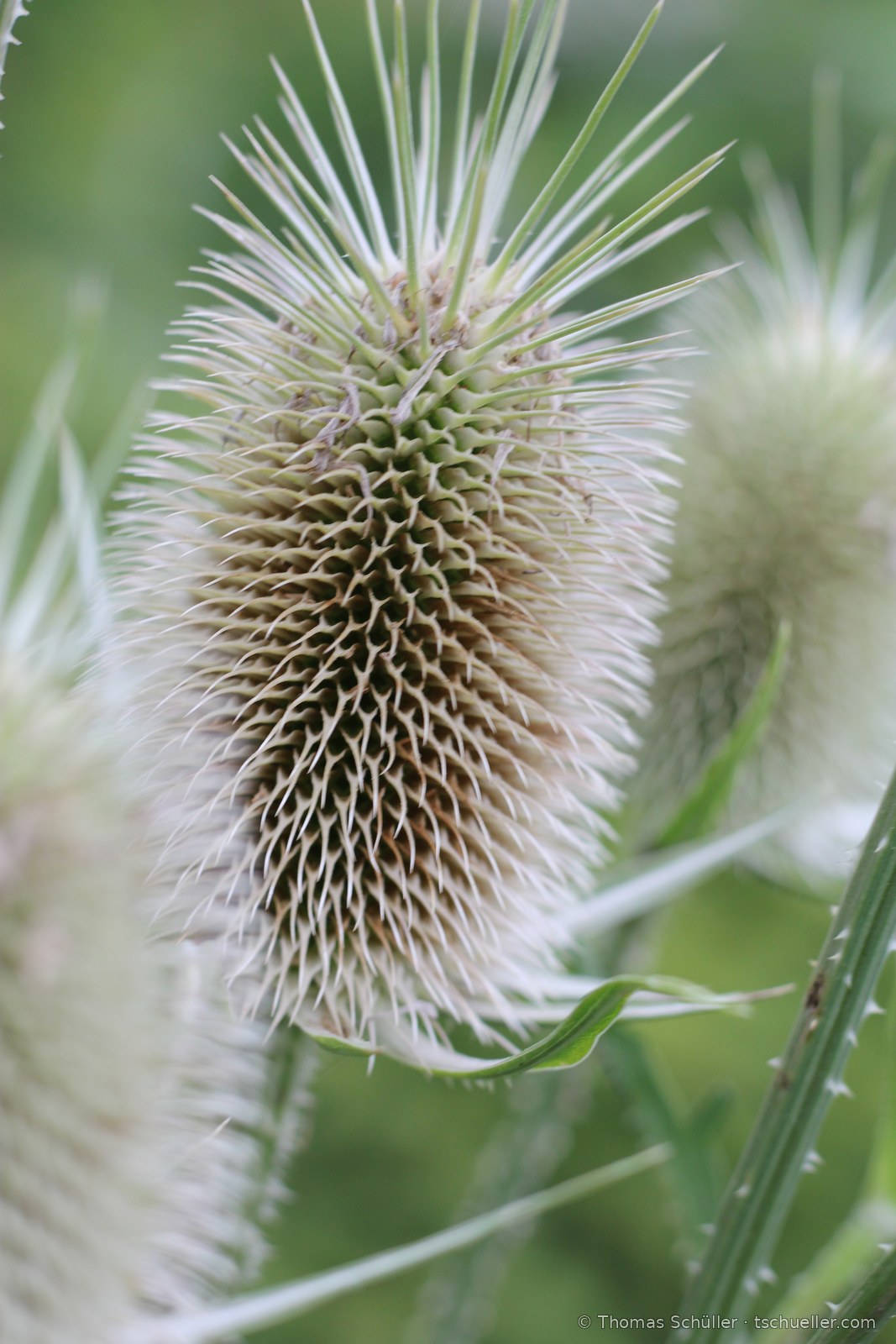
Teasel: the spiny head flowers in a ring that starts in the middle and moves up and down. Dried heads of the cultivated form were once used to raise the nap on cloth. Location not documented.
Karde: der stachelige Kopf blüht ringförmig, von der Mitte aus nach oben und unten. Getrocknete Köpfe der Weberkarde wurden früher zum Aufrauen von Tuch verwendet. Ort nicht dokumentiert.
No use without written permission: no reproduction, distribution, editing, or use for training machine-learning systems. For licensing, editorial use, prints or commercial use, please write — reasonable requests are usually met, and non-commercial and educational use is often granted free of charge.
Keine Nutzung ohne schriftliche Zustimmung: keine Vervielfältigung, Verbreitung, Bearbeitung oder Verwendung zum Training maschineller Lernsysteme. Für Lizenzen, redaktionelle Nutzung, Abzüge oder kommerzielle Verwertung bitte schreiben — sinnvolle Anfragen werden meist beantwortet, nicht-kommerzielle und Bildungsnutzung häufig kostenfrei erlaubt.